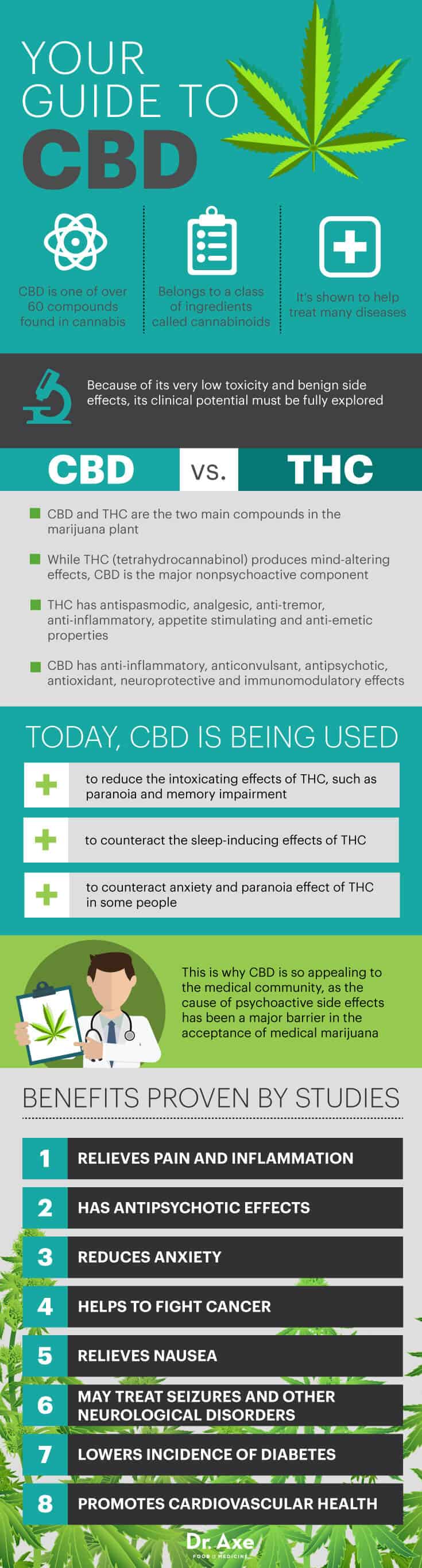
8 Proven Benefits of CBD
1. Relieves Pain and InflammationAmong common CBD benefits, natural pain relief tops the list for many. Evidence suggests that cannabinoids may prove useful in pain modulation by inhibiting neuronal transmission in pain pathways. A 2012 study published in the Journal of Experimental Medicine found that CBD significantly suppressed chronic inflammatory and neuropathic pain in rodents without causing analgesic tolerance. Researchers suggest that CBD and other nonpsychoactive components of marijuana may represent a novel class of therapeutic agents for the treatment of chronic pain. (4)
According to a 2007 meta-analysis conducted in Canada, the combination of CBD and THC buccal spray was found to be effective in treating neuropathic pain in multiple sclerosis, which can be debilitating for 50 to 70 percent of MS patients. (5)
2. Has Antipsychotic Effects
Research shows that CBD benefits include producing antipsychotic effects. It appears to have a pharmacological profile similar to that of atypical antipsychotic drugs as seen using behavioral and neurochemical techniques in animal studies. Additionally, studies show that CBD prevents human experimental psychosis and is effective in open case reports and clinical trials in patients with schizophrenia, with a remarkable safety profile. (6)
3. Reduces Anxiety
Studies using animal models of anxiety and involving healthy volunteers clearly suggest an anxiolytic-like effect of CBD. Cannabidiol has shown to reduce anxiety in patients with social anxiety disorder and researchers suggest that it may also be effective for panic disorder, obsessive compulsive disorder, social anxiety disorder and post-traumatic stress disorder. (7)
A 2011 study aimed to compare the effects of a simulation public speaking test on healthy control patients and treatment-native patients with social anxiety disorder. A total of 24 never-treated patients with social anxiety disorder were given either CBD or placebo 1.5 hours before the test. Researchers found that pretreatment with CBD significantly reduced anxiety, cognitive impairment and discomfort in their speech performance, and significantly decreased alertness in anticipation of their speech. The placebo group presented higher anxiety, cognitive impairment and discomfort. (8)
4. Helps to Fight Cancer
Several scientific reports demonstrate that CBD benefits include possessing antiproliferative, pro-apoptotic effects that inhibit cancer cell migration, adhesion and invasion. (9) A 2006 study published in the Journal of Pharmacology and Experimental Therapeutics found for the first time that CBD potently and selectively inhibited the growth of different breast tumor cell lines and exhibited significantly less potency in non-cancer cells. (10)
In 2011, researchers added light on the cellular mechanism through which CBD induces cell death in breast cancer cells. They showed that CBD induced a concentration-dependent cell death of both oestrogen receptor-positive and oestrogen receptor-negative breast cancer cells. They also found that the effective concentrations of CBD in tumor cells have little effect on non-tumorigenic, mammary cells. (11)
CBD behaves as a non-toxic compound and studies show that doses of 700 milligrams per day for 6 weeks did not show any overt toxicity in humans, suggesting that it can be used for prolonged treatment. Not only does the research show that CBD benefits including being effective in fighting breast cancer cells, data also suggests that it can be used to inhibit the invasion of lung and colon cancer, plus it possesses anti-tumor properties in gliomas and has been used to treat leukemia. (12)
5. Relieves Nausea
Cannabis has been used for centuries for the suppression of nausea and vomiting. Research has revealed that among more than 80 cannabinoid compounds found in marijuana, both the intoxicant THC and the non-intoxicant CBD helps to get rid of nausea and vomiting in animal studies. A 2012 study published in the British Journal of Pharmacology found that CBD benefits including possessing anti-nausea and antiemetic effects when it was administered to rats. (13) Researchers found that CBD acts in a diphasic manner, meaning that in low doses it suppresses toxin-induced vomiting, but in high doses it increases nausea or has no effect.
6. May Treat Seizures and Other Neurological Disorders
A 2014 survey conducted by researchers at Stanford University was presented to parents belonging to a Facebook group dedicated to sharing information about the use of cannabidiol-enriched cannabis to treat their child’s seizures. Nineteen responses met the inclusion criteria for the study: a diagnosis of epilepsy and current use of CBD-enriched cannabis. The average number of anti-epileptic drugs tried before using CBD cannabis was 12. Sixteen (84 percent) of the 19 parents reported a reduction in their child’s seizure frequency while taking CBD cannabis. Of these, two (11 percent) reported complete seizure freedom, eight (42 percent) reported a greater than 80 percent reduction in seizure frequency, and six (32 percent) reported a 25–60 percent seizure reduction. Other beneficial effects included increased alertness, better mood and improved sleep; while side effects included drowsiness and fatigue. (14)
Later in 2014, researchers reported on preliminary results of a study involving children with treatment-resistant epilepsies in an expanded access “compassionate use program.” Patients received a purified 98 percent oil-based CBD extract called Epidiolex, which is made by GW Pharmaceuticals. After 3 months of treatment, 39 percent of the 23 patients had more than a 50 percent reduction in seizures, with a 32 percent median reduction. These preliminary results support the animal studies and survey reports that CBD may be a promising treatment for treatment-resistant epilepsy and it is generally well-tolerated in doses up to 25 milligrams per kilogram of body weight. (15)
7. Lowers Incidence of Diabetes
A 2006 study found that CBD treatment significantly reduced the incidence of diabetes in non-obese diabetic mice from an incidence of 86 percent in non-treated mice to an incidence of 30 percent in CBD-treated mice. CBD benefits also showed a significant reduction of plasma levels of pro-inflammatory cytokines. A histological examination of the pancreatic islets of the CBD-treated mice revealed significantly reduced insulitis. (16)
In 2013, the American Journal of Medicine published a study that highlighted the impact of marijuana use on glucose, insulin and insulin resistance among U.S. adults. The study included 4,657 adult men and women from the National Health and Nutritional Examination Survey from 2005 to 2010. Of the participants, 579 were current marijuana users and 1,975 were past users. The researchers found that current marijuana use was associated with 16 percent lower fasting insulin levels. They also found significant associations between marijuana use and smaller waist circumferences, a factor connected to the onset of diabetes symptoms. (17)
8. Promotes Cardiovascular Health
A 2013 study published in the British Journal of Clinical Pharmacology reports that CBD protects against the vascular damage caused by a high glucose environment, inflammation or the induction of type 2 diabetes in animal models; plus, CBD proved to reduce the vascular hyperpermeability (which causes leaky gut) associated with such environments. (18)
CBD vs. THC
CBD and THC are the two main compounds in the marijuana plant and they are the only two cannabinoids that have been well characterized to date. Many strains of marijuana are known for having abundant levels of THC and high-CBD strains are less common; however, with the medical community paying more attention to the therapeutic effects of CBD, that is beginning to change.Both compounds have important health benefits: THC has antispasmodic, analgesic, anti-tremor, anti-inflammatory, appetite stimulating and anti-emetic properties, and CBD has anti-inflammatory, anticonvulsant, antipsychotic, antioxidant, neuroprotective and immunomodulatory effects.
The clinical use of THC is often limited by its unwanted psychoactive side effects, and for this reason interest in non-psychoactive phytocannabinoids, such as CBD, has substantially increased in recent years. In fact, CBD is being used to reduce the intoxicating effects of THC, such as paranoia and memory impairment. (19)
CBD also appears to counteract the sleep-inducing effects of THC. This is what makes CBD so appealing to the medical community, as the cause of psychoactive side effects has been a major barrier in the acceptance of medical marijuana. (20) While THC is known to cause anxiety and paranoia in some people, CBD works to counteract those side effects. For this reason, CBD benefits extend to being used in clinical trials on young children with epilepsy.
Another major difference between THC and CBD is that marijuana with high levels of THC is commonly used for its sleep-inducing effects, while CBD appears to promote wakefulness instead. (21)
How to Legally Acquire CBD
At the federal level, CBD is classified as a Schedule 1 drug in the United States because it is one of the many cannabinoids present in marijuana. To be labeled a schedule 1 drug means that it has a high potential for abuse and the potential to create severe psychological or physical dependence; therefore these drugs are not allowed to be used for medical use.Medical research can and is being done with schedule 1 substances, including CBD and other active ingredients in marijuana, but there are strict regulations and administrative hurdles associated with this status. According to the Federation of American Societies for Experimental Biology, the DEA is currently conducting a scientific review of CBD to elucidate its pharmacology and abuse liability and to identify gaps in the published literature. (22)
In 1996, California voters passed Proposition 215, allowing for the use of medical marijuana. Since then, 27 more states, plus the District of Columbia, Guam and Puerto Rico have enacted similar laws that allow for comprehensive public medical marijuana and cannabis programs.
More recently, 17 states have approved the use of low THC, high CBD products for medical reasons in limited situations. Each state has specific requirements and conditions that need to be followed in order to use CBD legally, such as patient registry requirements and definitions of products that are allowed. (23) The 17 states that allow limited access to marijuana products low in THC and high in CBD include:
- Alabama
- Florida
- Georgia
- Iowa
- Kentucky
- Louisiana
- Mississipi
- Missouri
- North Carolina
- Oklahoma
- South Carolina
- Tennessee
- Texas
- Utah
- Virginia
- Wisconsin
- Wyoming
- Idaho (vetoed by governor in 2015)
Precautions
Although the research on the medicinal use of cannabis is strong, several studies indicate that the recreational use of cannabis can have persistent adverse effects on mental health. According to a 2013 report published in Frontiers in Psychiatry, depending on how often someone uses, the age of onset, the potency of the cannabis that is used and someone’s individual sensitivity, the recreational use of cannabis may cause permanent psychological disorders. Most recreational users will never be faced with such persistent mental illness, but in some individuals cannabis use leads to undesirable effects, including cognitive impairment, anxiety, paranoia and increased risks of developing chronic psychosis or drug addiction. (24)Some studies show that CBD can counteract these adverse effects, but more research is needed, as most of this research is done on animals or is based on anecdotal reports. Little research has focused on the safety and side effects of CBD in humans; however, clinical trials indicate that only a few, generally mild side effects have been observed after CBD administration and tolerance for CBD does not seem to occur.
Final Thoughts
- CBD is one of over 60 compounds found in cannabis that belong to a class of ingredients called cannabinoids; it is the major nonpsychoactive component of Cannabis sativa.
- Research shows that CBD benefits include acting as an anti-inflammatory, anticonvulsant, antioxidant, antiemetic, anxiolytic and antipsychotic agent, and is therefore a potential medicine for the treatment of neuroinflammation, epilepsy, oxidative injury, vomiting and nausea, anxiety and schizophrenia.
- Many strains of marijuana are known for having abundant levels of THC and high-CBD strains are less common; however, with the medical community paying more attention to the therapeutic effects of CBD, that is beginning to change. CBD is being used to reduce the intoxicating effects of THC, such as paranoia and memory impairment.
- 17 states have approved the use of low THC, high CBD products for medical reasons in limited situations. Each state has specific requirements and conditions that need to be followed in order to use CBD legally, such as patient registry requirements and definitions of products that are allowed.
Read Next: Hemp Seed Benefits
From the sound of it, you might think leaky gut only affects the digestive system, but in reality it can affect more. Because Leaky Gut is so common, and such an enigma, I’m offering a free webinar on all things leaky gut.


